
 Back to Resources

The Hidden Cost of Carton Variation Across Apparel Factories
Carton variation is one of the most common packaging problems apparel brands overlook. It often starts small, with a few factory-level exceptions or one-off carton sizes, then expands across suppliers, regions, and product lines until it creates hidden costs throughout the supply chain.
For mid-to-large apparel, footwear, sporting goods, and outdoor equipment brands, those costs rarely appear in one obvious place. They show up in freight inefficiency, distribution center slowdowns, product damage, manual handling, planning complexity, and lost operational control.
The issue isn't simply that too many cartons exist, it’s that carton variation makes the supply chain harder to predict, harder to optimize, and harder to manage at scale.
Key Takeaways
- Carton variation happens when brands use too many carton sizes across factories, suppliers, or regions.
- Inconsistent carton sizing creates hidden costs in freight, distribution, labor, damage, and planning.
- Apparel brands are especially vulnerable because global sourcing and factory-level decisions often create packaging exceptions over time.
- Packaging optimisation helps standardise carton sizes around real order patterns, logistics requirements, and distribution center needs.
- Long-term control requires governance, visibility, and ongoing monitoring so carton variation does not return.
What Is Carton Variation, and Why Does It Happen?
Carton variation occurs when brands use too many carton sizes across factories, suppliers, or regions. Over time, inconsistent packaging creates inefficiencies that increase freight costs, disrupt distribution operations, and add complexity throughout the supply chain.
In apparel manufacturing, carton variation usually does not appear overnight. It builds gradually.
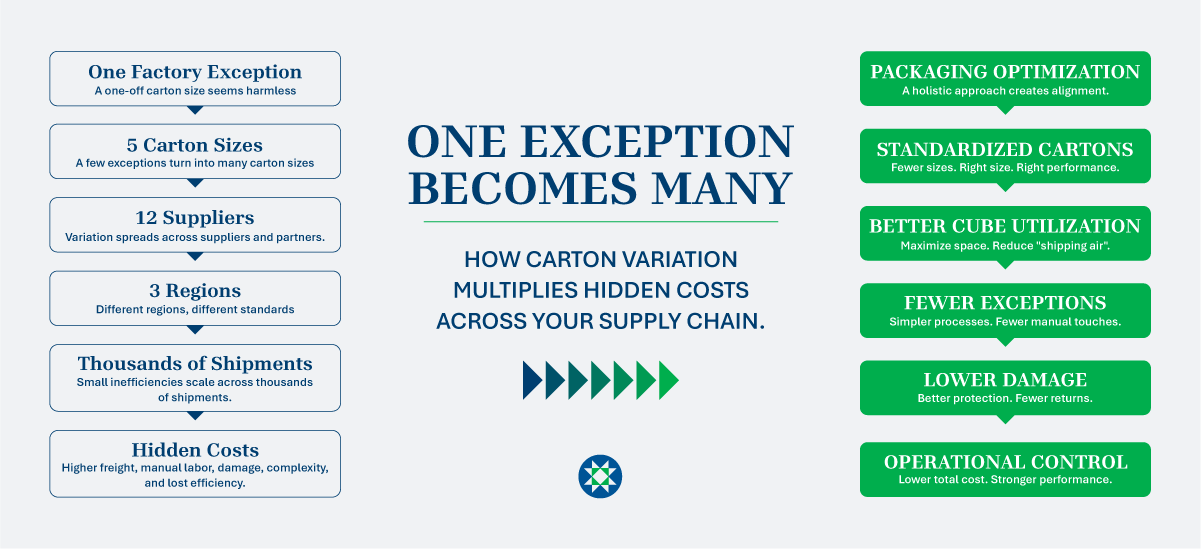
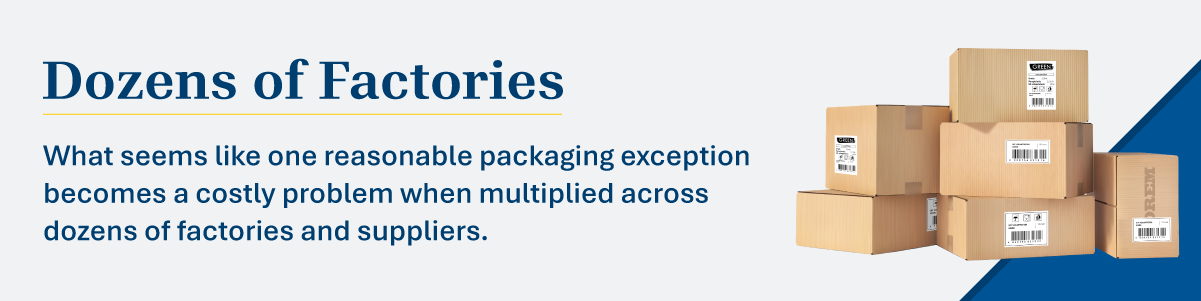
One factory may create an exception carton for a specific product run. Another supplier may use a locally available carton size. A different region may modify packaging to solve a short-term shipping issue. Each decision may seem reasonable in isolation, but across dozens of factories and thousands of shipments, those exceptions multiply.
The result is a fragmented packaging system where carton sizes, materials, dimensions, and performance standards vary widely across the network.
For brands with global sourcing models, this problem becomes especially difficult to control. Packaging decisions are often made close to the factory floor, while the cost impact appears later in freight, distribution, or customer experience. Without centralised visibility, teams may not realise how much variation exists or how much it is costing the business.
The Hidden Costs of Carton Variation
Carton variation creates hidden costs because the problem is distributed across the supply chain. No single team feels the full impact. Freight teams see wasted space. Distribution teams see inconsistent handling. Quality teams see product damage. Planning teams see exceptions. Individually, each issue may look manageable. Together, they create a costly and persistent operational problem.
Freight Inefficiency and “Shipping Air”
One of the most immediate costs of carton variation is freight inefficiency.
When carton sizes are inconsistent, containers, trailers, and pallets become harder to cube efficiently. Poor carton fit creates unused space, often referred to as “shipping air.” Instead of maximising each shipment, brands may pay to move partially utilised capacity across long distances.
For apparel and footwear brands, this issue can be especially expensive because products often move through international freight networks before reaching domestic distribution centers. Even small inefficiencies in carton dimensions can scale into significant cost waste when multiplied across thousands of cartons, containers, and purchase orders.
Carton variation also makes freight planning less predictable. If teams cannot rely on standardized carton dimensions, they have a harder time forecasting container utilisation, estimating shipment volume, and planning transportation capacity with confidence.
Distribution Center Inefficiencies
Carton variation does not stop creating problems once products arrive at the distribution center.
Receiving, storage, sortation, picking, palletisation, and automation all depend on a certain level of predictability. When carton dimensions vary too widely, teams spend less time moving goods through a repeatable process and more time adjusting around exceptions. That friction can show up in several ways:
- More manual handling
- More repacking
- Slower throughput
- Poorer pallet stability
- Less efficient storage
- More exceptions in automated systems
For distribution centers using automation, inconsistent cartons can be especially disruptive. Systems built around predictable dimensions may struggle with cartons that fall outside expected size, weight, or material ranges. When automation cannot process a carton efficiently, the work often shifts back to labor.
That creates a direct cost impact. Teams spend more time managing exceptions instead of moving goods efficiently through the operation.
Product Damage and Returns
Carton variation can also increase the risk of product damage.
When carton sizes are not aligned with the actual product mix, items may have too much room to move during transit or too little protection around key stress points. Poor fit creates opportunities for crushing, shifting, abrasion, and deformation.
Material inconsistency adds another layer of risk. If factories use different carton specifications, brands may see inconsistent performance across shipments. Some cartons may hold up well during international transit, while others may fail under stacking pressure, moisture exposure, or repeated handling.
Damage does more than create replacement costs. It affects customer experience, return rates, sell-through, and brand perception. For consumer product brands, especially those selling through retail and direct-to-consumer channels, damaged goods can create downstream issues that go far beyond packaging.
Planning Complexity and Loss of Control
Perhaps the most underestimated cost of carton variation is complexity.
When carton standards are inconsistent, teams lose visibility and control. This creates a planning environment where teams are constantly reacting.
Instead of managing a controlled packaging system, brands manage a growing network of one-off decisions. Each exception adds another variable to freight planning, distribution operations, and supplier performance management.
Over time, this complexity reduces operational confidence. Teams may know something is inefficient, but without a clear view of carton variation across the supplier network, they may not know where to begin.
Why Carton Variation Persists
Carton variation persists because it rarely has a single owner. Each team sees part of the problem, but no one owns the full system.
This fragmented ownership makes carton variation easy to underestimate.
Factories and OEMs may also resist standardisation if existing carton practices feel easier or cheaper at the local level. A factory may prefer to use available materials, familiar suppliers, or carton sizes that solve immediate production needs. Without clear governance, those factory-level preferences can override broader supply chain efficiency.
Internal bandwidth is another challenge. Packaging optimization often requires data collection, supplier coordination, testing, implementation, and ongoing monitoring. For teams already managing seasonal launches, demand shifts, production timelines, and freight pressure, carton standardization can feel important but not urgent.
That is why carton variation often remains unresolved for years. The cost is real, but it is hidden across functions, systems, and regions.
How Packaging Optimisation Solves the Problem
Packaging optimisation solves carton variation by turning packaging from a decentralised factory-level decision into a controlled supply chain performance lever.
The goal is not simply to use fewer cartons. The goal is to create a packaging system that supports freight efficiency, distribution center performance, product protection, and long-term operational control.
Standardising Carton Sizes
The first step is reducing the total number of carton sizes across factories, suppliers, and regions.
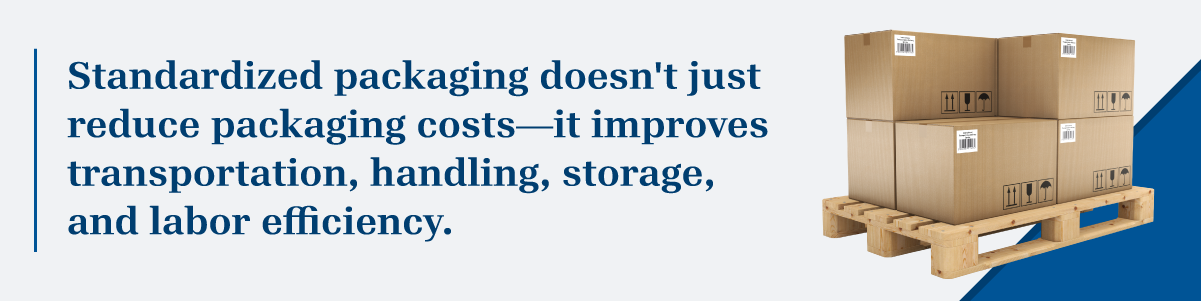
Standardisation creates consistency. When carton dimensions are controlled, teams can plan shipments more accurately, improve palletisation, reduce handling complexity, and simplify supplier expectations.
For apparel brands, this does not mean forcing every product into a single carton size. It means creating a rationalised carton set that supports the real product mix without allowing unnecessary variation to grow unchecked.
In practice, that requires looking beyond the carton itself. The most effective programs account for how products are ordered, shipped, handled, and stored throughout the supply chain. Factors that influence carton design decisions include:
- Product dimensions
- Order profiles
- Pack quantities
- Freight requirements
- Distribution center handling needs
- Supplier capabilities
- Damage performance
The result is a carton system designed around operational reality, not accumulated exceptions.
Designing Around Real Order Patterns
Effective packaging optimisation depends on data. Many brands design packaging around individual products without fully considering how those products move through the supply chain. A carton may appear appropriate at the item level but perform poorly once order quantities, mixed shipments, container loading, and distribution requirements are considered.
The challenge is that products are rarely shipped the same way they're designed. Once real order behavior enters the equation, packaging decisions start affecting everything from freight utilisation to product protection. Brands that design around actual order patterns often see improvements in:
- Product fit
- Carton utilisation
- Freight efficiency
- Handling consistency
- Damage protection
- Operational predictability
For apparel, footwear, sporting goods, and outdoor equipment brands, this matters because product dimensions and shipment profiles vary widely. Packaging optimisation must account for that complexity without allowing the carton system itself to become unmanageable.
Aligning With Logistics and DC Requirements
Packaging cannot be optimized in isolation.
A carton that works for a factory may not work for ocean freight. A carton that works for freight may not work for palletisation. A carton that works for palletisation may not work for distribution center automation. That is why packaging optimisation must align with logistics and DC requirements from the start. The right carton strategy should support:
- Container loading
- Pallet configuration
- Storage efficiency
- Automated handling
- Manual handling
- Sortation
- Repacking reduction
- Product protection
When packaging is aligned with downstream requirements, the supply chain becomes easier to manage. Freight teams gain predictability. Distribution teams handle fewer exceptions. Quality teams see fewer damage risks. Planning teams gain better control.
Establishing Ongoing Control
Carton variation can return if brands do not establish governance.
A one-time optimisation project may reduce carton counts, but without ongoing control, factories can gradually reintroduce exceptions. New product lines, new suppliers, regional preferences, urgent orders, and material availability can all create pressure to deviate from standards.
In many organisations, this is where progress starts to unravel. What begins as a standardised packaging program can slowly accumulate new exceptions until the same inefficiencies reappear across the network. Preventing that drift requires a combination of:
- Clear carton standards
- Supplier compliance expectations
- Factory-level implementation guidance
- Approval processes for exceptions
- Monitoring across regions and suppliers
- Regular reviews as product and order patterns change
This is where packaging optimisation becomes an operating discipline rather than just a cost-saving initiative.
What Happens When You Get It Right
When brands reduce carton variation, the benefits extend across the supply chain.
Freight becomes more efficient because cartons cube better into containers and trailers. Distribution centers operate more smoothly because teams handle fewer exceptions. Products are better protected because carton fit and material performance are more consistent. Planning improves because teams gain better visibility into packaging requirements across suppliers.
In addition to gaining this data to support evolving packaging regulations, the biggest benefit may be control
Instead of absorbing hidden costs from dozens of factory-level packaging decisions, brands gain a more predictable packaging system. That system supports better freight planning, faster DC operations, lower complexity, and stronger overall packaging optimisation performance.
For mid-to-large consumer product brands, especially those managing large supplier networks, that control can become a competitive advantage.
The First Step: Make the Hidden Costs Visible
Many brands cannot solve carton variation because they have not fully measured it. Without a clear view of carton variation across factories, the root cause often remains hidden.
That's what makes carton variation so difficult to address. Most teams experience the symptoms, but few have a complete picture of how those symptoms connect back to packaging decisions.
Creating that picture typically starts with questions like:
- How many carton sizes are currently in use?
- Which factories or regions create the most variation?
- Where do carton dimensions reduce freight efficiency?
- Where do inconsistent cartons create DC handling issues?
- Which products are most vulnerable to poor fit or damage?
- Which exceptions should be eliminated, controlled, or redesigned?
Once brands can see the full impact of carton variation, packaging optimisation becomes easier to prioritise. The conversation shifts from “cartons are inconsistent” to “carton variation is increasing cost, complexity, and risk across the supply chain.” That shift is where meaningful improvement begins.
See How Leading Apparel Brands Solved Carton Variation
Carton variation may begin as a packaging issue, but it rarely stays there. Left unmanaged, it affects freight utilisation, distribution performance, product protection, supplier control, and overall supply chain efficiency.
For apparel, footwear, sporting goods, and outdoor equipment brands, packaging optimisation provides a path to reduce complexity and create measurable operational value.
Explore how a global apparel brand reduced complexity, improved efficiency, and unlocked measurable savings through packaging optimisation.
Frequently Asked Questions About EU Packaging Regulations
What is carton variation?
Carton variation occurs when a brand uses too many carton sizes, specifications, or packaging standards across factories, suppliers, or regions. Over time, this lack of standardisation creates inefficiencies that increase costs and operational complexity throughout the supply chain.
How does carton variation increase freight costs?
Inconsistent carton sizes often reduce container and trailer utilisation, creating unused space known as "shipping air." Poor utilisation means brands pay to transport less product per shipment, increasing overall freight costs and reducing transportation efficiency.
Why is carton variation common in apparel supply chains?
Apparel brands frequently source products from multiple factories and regions. Packaging decisions are often made at the factory level to address local requirements or short-term challenges. Without centralised governance, these decisions accumulate and create significant carton variation across the network.
What is packaging optimisation?
Packaging optimisation is the process of improving packaging design, carton sizing, material selection, and packaging standards to reduce costs and improve supply chain performance. Effective packaging optimisation aligns packaging decisions with freight, distribution center, product protection, and operational requirements.
How can brands reduce carton variation?
Reducing carton variation typically begins with assessing existing carton usage across factories and suppliers. Brands can then standardise carton sizes, align packaging with real order patterns and logistics requirements, and establish governance processes that prevent unnecessary variation from returning over time.
 |
Iain Dawson helps global brands unlock growth through smarter packaging and streamlined supply chain strategies. |

